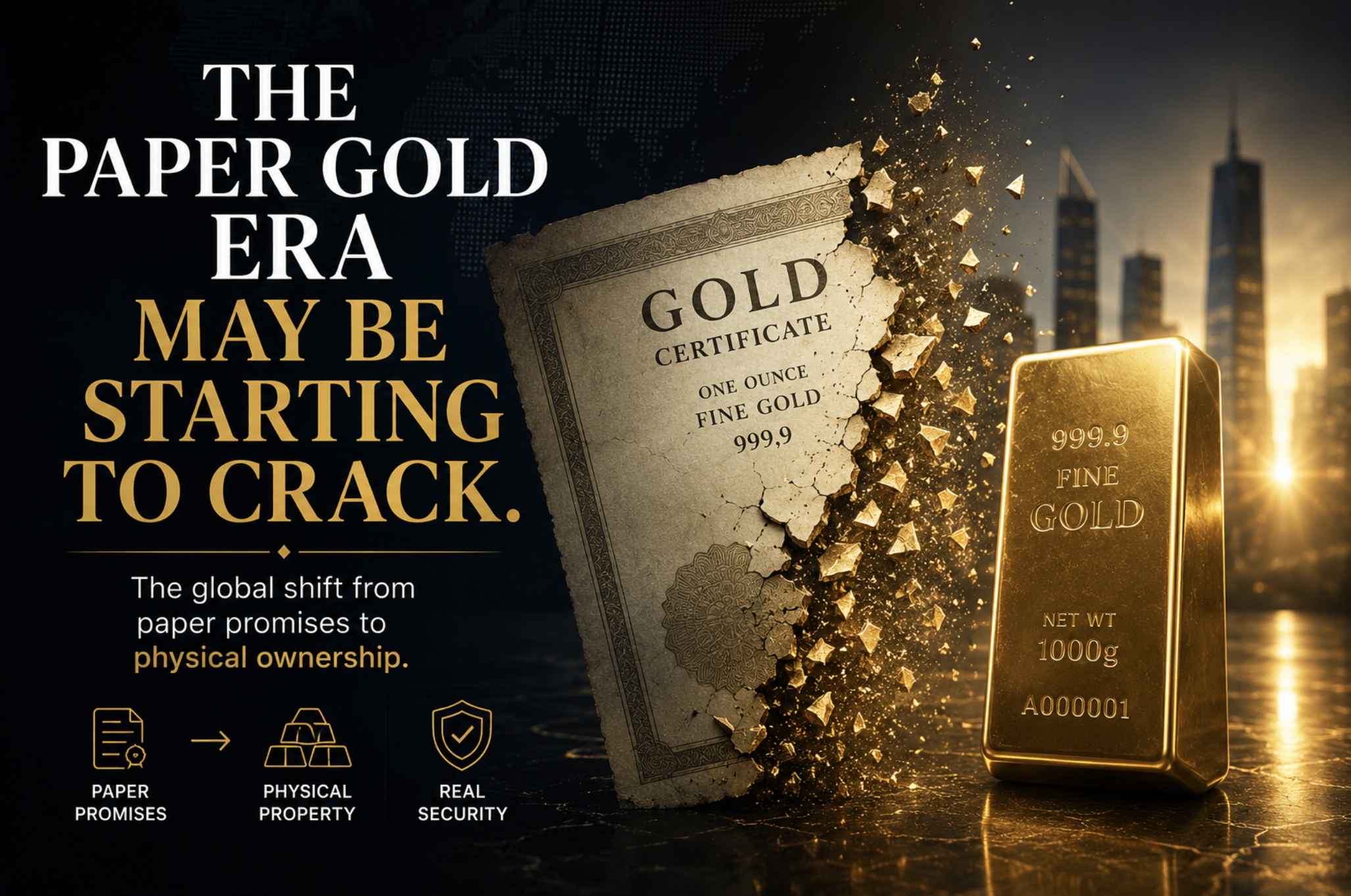
The paper gold era may be starting to crack.
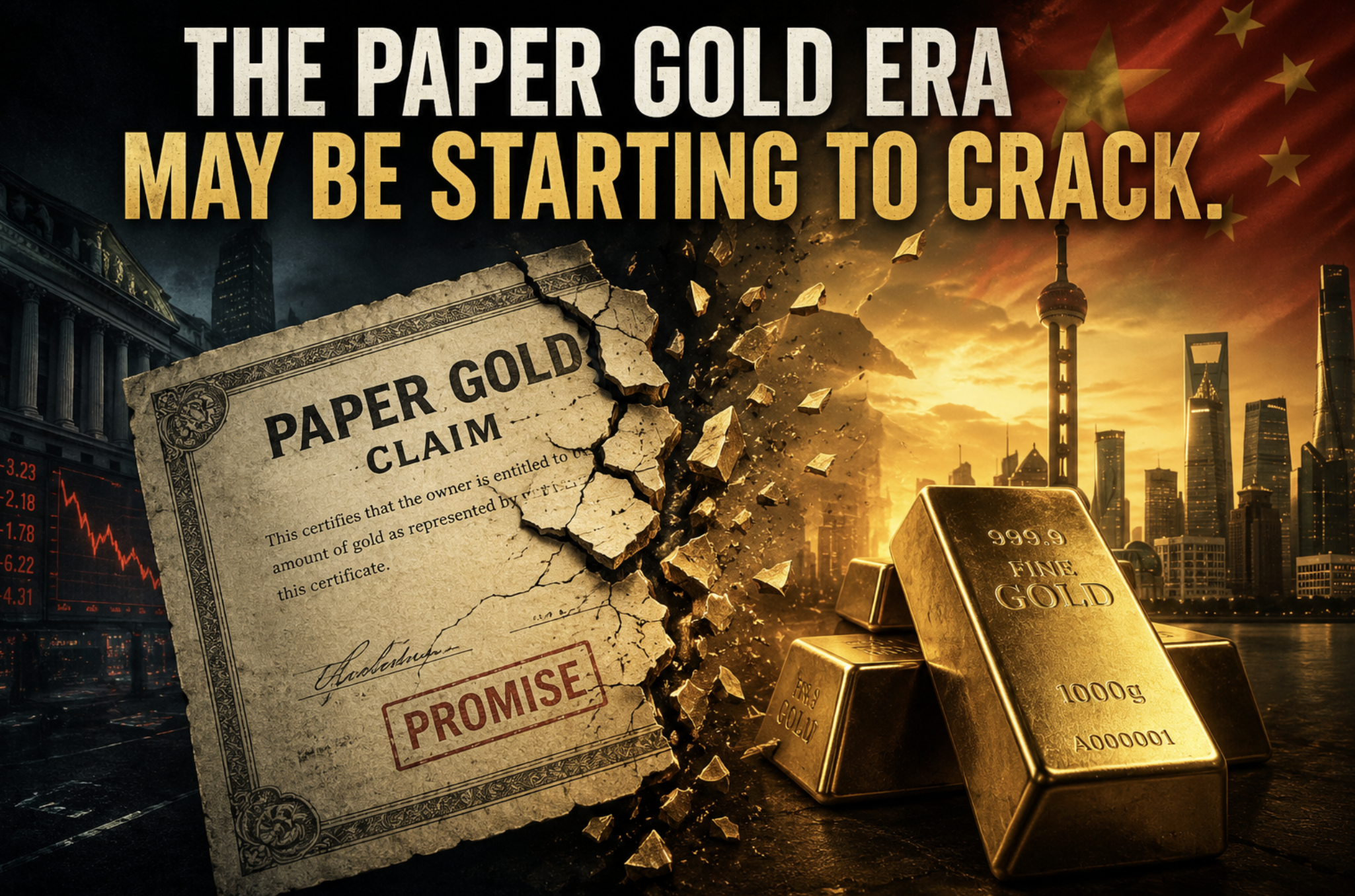
For decades, the global gold price has been influenced by a system built on promises rather than physical metal, and we now are all well aware, any promise given, can be broken.
You buy gold (paper).
You receive a certificate, an ETF, a futures contract or another paper claim.
In many cases, no gold actually changes hands (ever).
That system has worked because most investors never ask for delivery.
Now something significant appears to be changing. What happens when everyone asks for the physical Gold?
China has announced that many of its largest banks will suspend retail paper gold trading, with customers instead being required to either close their positions or take physical delivery. At the same time, China continues to develop a market that places greater emphasis on physically settled gold contracts.
Whether this becomes a turning point remains to be seen.
But it deserves attention.
Why this matters
Imagine there were 100 tickets sold for a concert with only 10 seats.
As long as only a few people turn up, nobody notices.
But if everyone arrives together, the shortage becomes obvious.
The gold market can work in a similar way.
Many financial products give exposure to the gold price without requiring physical bullion to move.
That creates far more paper claims than physical metal changing hands.
Critics argue this increases liquidity.
Supporters argue it suppresses prices by creating additional synthetic supply.
Both sides agree on one thing.
Physical gold and paper gold are not the same asset.
China appears to be backing physical ownership
For years, China has been quietly building an alternative gold infrastructure.
The Shanghai Gold Exchange has long emphasised contracts that can be physically settled rather than remaining purely financial instruments.
More recently, Hong Kong has expanded its own gold clearing and settlement infrastructure, making it easier for international investors to access physically settled markets.
The direction of travel appears clear, (I think)...
Greater emphasis on physical ownership.
Less emphasis on synthetic exposure.
Meanwhile, central banks are doing something interesting
Forget the headlines.
Watch what the world's largest balance sheets are actually buying.
Central banks have been purchasing gold at historically high levels over recent years.
Why?
Because physical gold carries no counterparty risk. Zero.
It is not someone else's promise.
It cannot be printed.
It does not depend on another institution remaining solvent.
That does not mean governments or central banks believe gold prices will immediately surge.
It simply suggests they continue to view physical gold as an important reserve asset during an increasingly uncertain geopolitical and financial environment.
Promises versus property
Every investment broadly falls into one of two categories.
A promise
Someone owes you something.
Cash.
Government bonds.
Corporate bonds.
Bank deposits.
Many ETFs.
Derivative contracts.
These all depend on another party honouring an obligation.
Property
You own the asset itself.
Physical gold.
Physical silver.
Land.
Property.
Fine art.
Certain digital assets where you hold your own keys.
There is no promise.
There is ownership.
That distinction becomes increasingly important whenever confidence in financial systems is tested.
Does this mean gold prices are about to explode?
Not necessarily.
Markets are influenced by hundreds of factors including interest rates, currencies, inflation expectations, investor sentiment and central bank policy.
"Nobody can honestly guarantee where gold goes next. Ever." Kane White, mentions.
However...
If global markets continue moving towards physical settlement and physical ownership, the balance between paper claims and available bullion becomes increasingly important.
That is something every investor should understand.
The question worth asking
The biggest institutions in the world appear to be increasing allocations to physical gold.
China is building infrastructure around physical settlement.
Central banks continue buying bullion.
The discussion is slowly shifting from financial claims to tangible ownership.
The question is no longer simply:
"Should I own gold?"
Perhaps the better question is:
"If I choose to own gold, do I actually own the metal, or do I own a promise that someone else owes me?"
That distinction may become one of the most important investment questions of the coming decade.
At Britannia Bullion, we have a wealth of expirence surrounding Gold ownership. If you have any questions, get in contact.
.png?width=1280&height=500&name=Gold%20Investment%20Outreach%20Existing%20(3).png)
Important note
This article is for information and educational purposes only and should not be considered financial advice. The future performance of gold cannot be guaranteed. Investors should consider their own objectives, risk tolerance and, where appropriate, seek independent financial advice before making investment decisions.