Everyone knew it was there.
Everyone understood what might happen if it were opened.
But markets behaved as if the lid would stay shut forever.
Now it has been lifted.
And once Pandora’s Box is opened, the problem is not what comes out first, it is that nothing goes back inside.
What began as a regional confrontation is rapidly morphing into something far more dangerous: a conflict centred on the energy heart of the global economy.
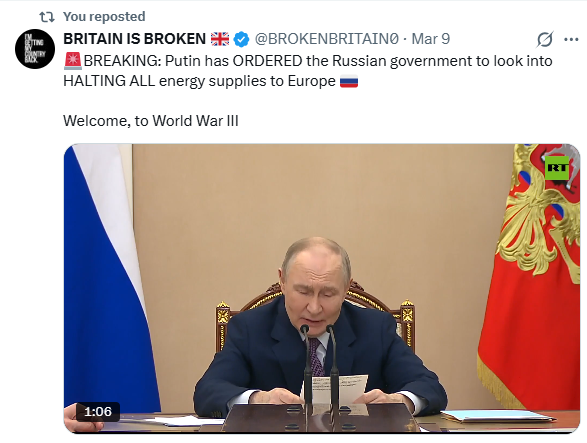
Now, take this with a pinch of salt, but I got sent this yesterday; Kane White. Click the video to watch!
Note that this is not an outright "halt now" order but an instruction to evaluate it as a pre-emptive move.
If this war escalates further, the consequences will not remain confined to the Middle East. They will ripple across oil markets, global shipping, inflation, financial markets and ultimately the stability of the world economy itself.
And the sequence of events is not difficult to imagine.
The First Domino: Oil
The Strait of Hormuz is the single most important energy chokepoint on Earth.
Roughly 20% of the world’s oil supply passes through that narrow stretch of water every single day.
If conflict disrupts this route, even briefly, oil markets will react instantly.
It does not take a full blockade. A handful of damaged tankers, naval engagements, or an explosion in shipping insurance costs can be enough to halt traffic.
In that environment oil does not move gradually.
It spikes.
$120 a barrel becomes $150.
$150 becomes $200.
And once energy prices move at that speed, they spread like wildfire through the global economy.
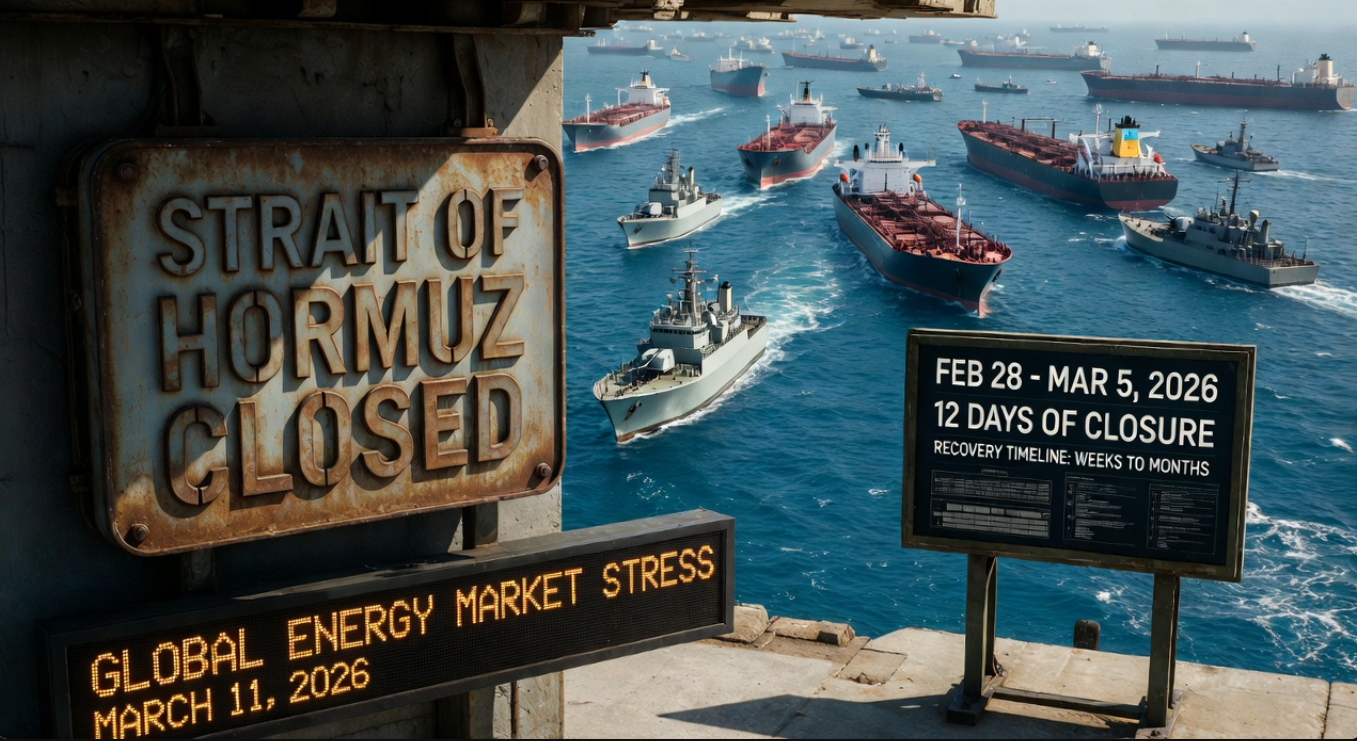
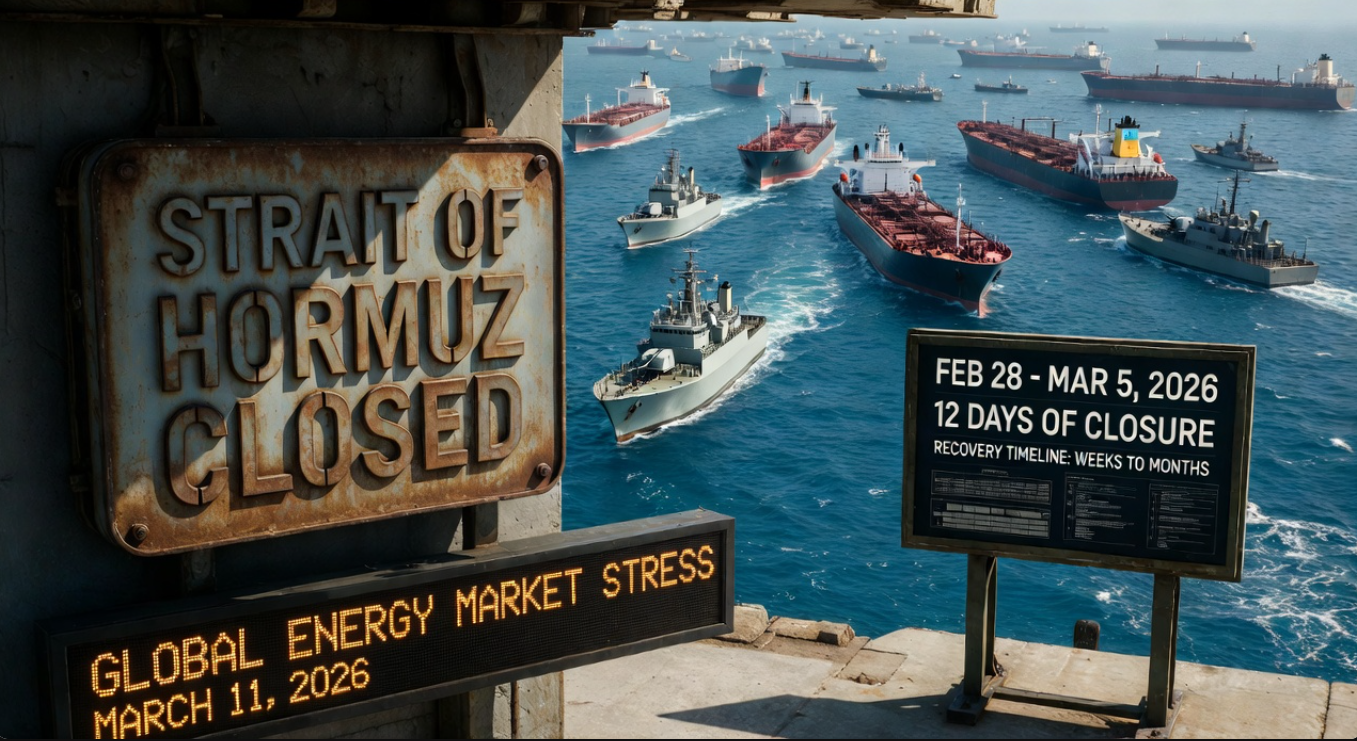
As of March 11, 2026, the Strait of Hormuz has been effectively closed to normal commercial traffic for about 12 days, with no signs of reopening.
The effective shutdown followed U.S. and Israeli strikes on Iran starting February 28, 2026. Traffic dropped sharply by March 1–2, when a senior IRGC official declared the strait closed on March 2, 2026, and threatened attacks on any transiting ships.
Major tanker movements halted around March 3, with insurance coverage largely cancelled from March 5 onward. The strait remains effectively closed to most commercial vessels, though limited Iran-linked or "dark" traffic continues.
Each additional day disrupts roughly 15–20 million barrels of daily global oil supply (about 20% of seaborne crude), contributing to volatile oil prices, Brent crude has seen surges (briefly nearing $120/barrel earlier in the crisis) and recent levels around $89–$92/barrel amid fluctuations, risk premiums, production shut-ins in the region, forced rerouting via longer routes (adding 10–14 days per voyage), and widespread energy cost increases rippling into inflation and supply-chain pressures.
Recovery remains uncertain and depends on de-escalation or security measures. Partial resumption of traffic could occur in days to a few weeks with improvements like naval escorts or reduced threats, but full normalization, stable volumes, restored insurer confidence, and cleared backlogs, is likely to take weeks to several months. Prolonged disruption could extend lingering effects (e.g., supply shortages, elevated premiums) for 3–6 months or more, per analyst estimates.
Shipping Freezes Before the First Missile Lands
Most people imagine war disrupting shipping through physical attacks.
In reality, global trade often freezes before the shooting even escalates.
The real trigger is insurance.
If insurers decide the risks are too high, premiums can rise thousands of percent overnight.
At some point ships simply stop sailing.
No insurance means no cargo.
Suddenly oil cannot leave the Gulf.
Liquefied natural gas shipments stall.
Food imports into the region slow dramatically.
Supply chains, already fragile after years of geopolitical tension, seize up once again.
Inflation Returns With a Vengeance
Energy is the bloodstream of the global economy.
When oil surges, everything becomes more expensive.
Transport.
Manufacturing.
Food production.
Heating.
The inflation shock arrives within weeks.
Central banks that had been hoping inflation was finally under control suddenly face the opposite problem: another inflation wave driven by geopolitics rather than demand.
Interest rates cannot easily solve this type of inflation.
Higher rates cannot pump more oil out of the ground.
So central banks face an impossible choice:
Raise rates and crush growth, or tolerate rising inflation.
Financial Markets Reprice the World
Financial markets have spent years operating under an assumption that geopolitical risks remain manageable.
A sustained Middle East war would shatter that assumption.
Equity markets do not like uncertainty.
They like stability, predictable supply chains, and functioning global trade.
Take those away and investors begin to price in recession risk extremely quickly.
Energy-dependent economies across Europe and Asia would be particularly vulnerable.
Countries such as India, Japan and South Korea, heavily reliant on Gulf oil shipments, would face immediate economic pressure.
Emerging markets, already burdened by debt, could experience severe currency instability.
The ripple effects would spread through the global financial system.
Governments Reach for the Only Tool They Know
When economies weaken and markets wobble, governments historically respond the same way.
They spend.
Stimulus packages.
Military spending.
Energy subsidies.
Emergency economic support.
And when governments spend beyond their means, central banks often end up doing what they have done repeatedly in the past:
creating money to support the system.
More liquidity.
More debt.
More currency dilution.
And Then There Is Gold
Gold tends to move when something in the financial system is signalling stress.
War.
Currency debasement.
Inflation shocks.
Financial instability.
In other words, the very conditions that emerge when Pandora’s Box is opened.
Gold is not reacting to headlines alone.
It is reacting to the structure of risk building beneath the global economy.

The Lesson of Pandora
The myth of Pandora’s Box ends with a final detail many people forget.
After all the chaos escaped into the world, disease, conflict, hardship, one thing remained inside the box.
Hope.
History shows that global crises eventually pass.
Markets recover.
New systems emerge.
But between the moment the box opens and the moment stability returns, the world often travels through a period of severe disruption.
If the current conflict escalates further, the economic consequences could be felt far beyond the battlefield.
Because once Pandora’s Box is opened…
The world must deal with everything that comes out.
Disclaimer
This email is for informational purposes only and does not constitute investment, financial, legal, or professional advice.
All information is based on publicly available sources as of March 11, 2026, and is subject to change.
Geopolitical events, energy markets, oil prices, and recovery timelines involve significant uncertainty and risks; actual outcomes may differ materially.
Forward-looking statements are not guarantees of future results.
The sender disclaims all liability for any reliance on or use of this content.
Recipients should verify information independently and consult qualified professionals as needed.