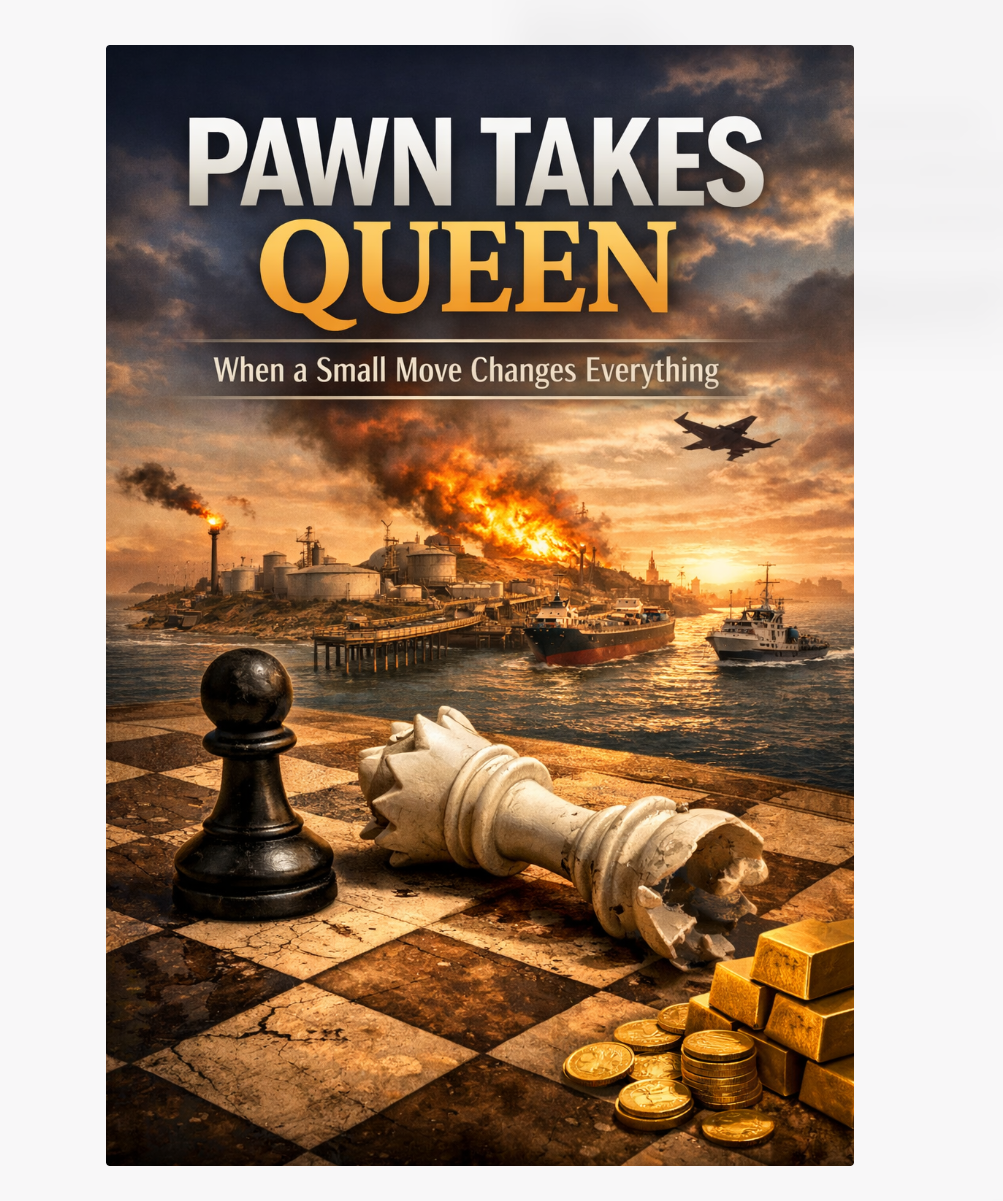
In chess, the smallest piece on the board can sometimes make the move that changes everything.
A pawn, slow, underestimated, often ignored, advances quietly until suddenly it removes the most powerful piece in the game.
Pawn takes queen.
Game transformed.
Right now, in the Persian Gulf, there is a place that resembles that pawn.
The Pawn: Kharg Island
Just 25 kilometres off the Iranian coast sits a small, dusty island called Kharg.
It is not large.
It is not glamorous.
Few people outside the energy world have ever heard of it.
And yet a significant portion of Iran’s oil exports leave the country from this one island.
Pipelines from Iran’s giant inland oil fields run directly to Kharg’s storage tanks and export terminals, where supertaskers load crude bound largely for Asia, particularly China.
Many industry estimates suggest roughly 90–95% of Iran’s crude exports pass through this single point.
Which means that if Kharg were ever disabled, blockaded, or significantly disrupted, Iran’s ability to export oil could be severely impacted.
That is why energy analysts often describe it as one of the most sensitive oil export locations in the region.
The Queen: The Global Energy System
The global economy runs heavily on oil.
Even small disruptions in supply can cause markets to react quickly.
Energy prices
Food production
Shipping costs
Inflation
Interest rates
Financial markets
Iran may represent only a few percent of global supply, but in a market already influenced by geopolitics and fragile logistics, even small changes can have wider consequences.
If exports from Kharg were ever disrupted, the effects would likely extend beyond the region.
Energy markets are highly interconnected.
Why It Has Not Been Touched
That is precisely why it has remained largely untouched.
Any direct strike on such infrastructure could potentially provoke wider regional consequences, including tensions around the Strait of Hormuz, through which roughly one fifth of the world’s oil supply moves each day.
Even temporary disruption to that corridor would likely cause sharp reactions in energy markets.
Energy prices could rise quickly.
Shipping insurance costs could increase.
Supply chains could tighten.
In other words, a relatively small geographic point has the potential to influence the global system.
When Small Things Change Big Systems
History rarely shifts because of the most obvious headline.
More often, it begins with something smaller, a miscalculation, a pressure point, or an unexpected event.
A pawn moves forward.
And suddenly the entire board changes.
Markets are not designed for stability during moments like this.
They are designed to reprice risk.
Quickly.
The Canary in the Coal Mine
Gold has historically had a habit of reacting early during periods of uncertainty.
Not because gold predicts events with certainty.
But because it often reflects something more subtle, confidence in financial systems.
When the world feels stable, gold can be ignored.
When the world begins to look fragile…
when geopolitical tensions rise…
when energy markets become volatile…
gold tends to attract renewed attention.
A Quiet Reminder
Nobody knows exactly how events will unfold.
Conflicts escalate.
Diplomacy intervenes.
Markets overreact, and then correct.
But one principle has remained consistent for centuries:
When uncertainty rises, many investors choose to hold assets that historically acted as financial insurance.
Gold has served that role longer than any currency, government, or financial institution currently in existence.
And during moments when the global chessboard begins to look unstable, its purpose becomes easier to understand.
This article is provided for general market commentary and educational purposes only. It does not constitute financial advice or a recommendation to buy or sell any investment. Readers should conduct their own research and seek independent professional advice before making financial decisions.