Matthew Jones writes... For more than ten years, those of us concerned about the future of money have been warning about a simple question:
What happens when money becomes fully digital?
At the time, these concerns were often dismissed as conspiracy theories. We were told governments would never seek to control how people spend their money. We were assured that digital currencies would simply be a more convenient form of cash.
Yet this week, we witnessed something significant.
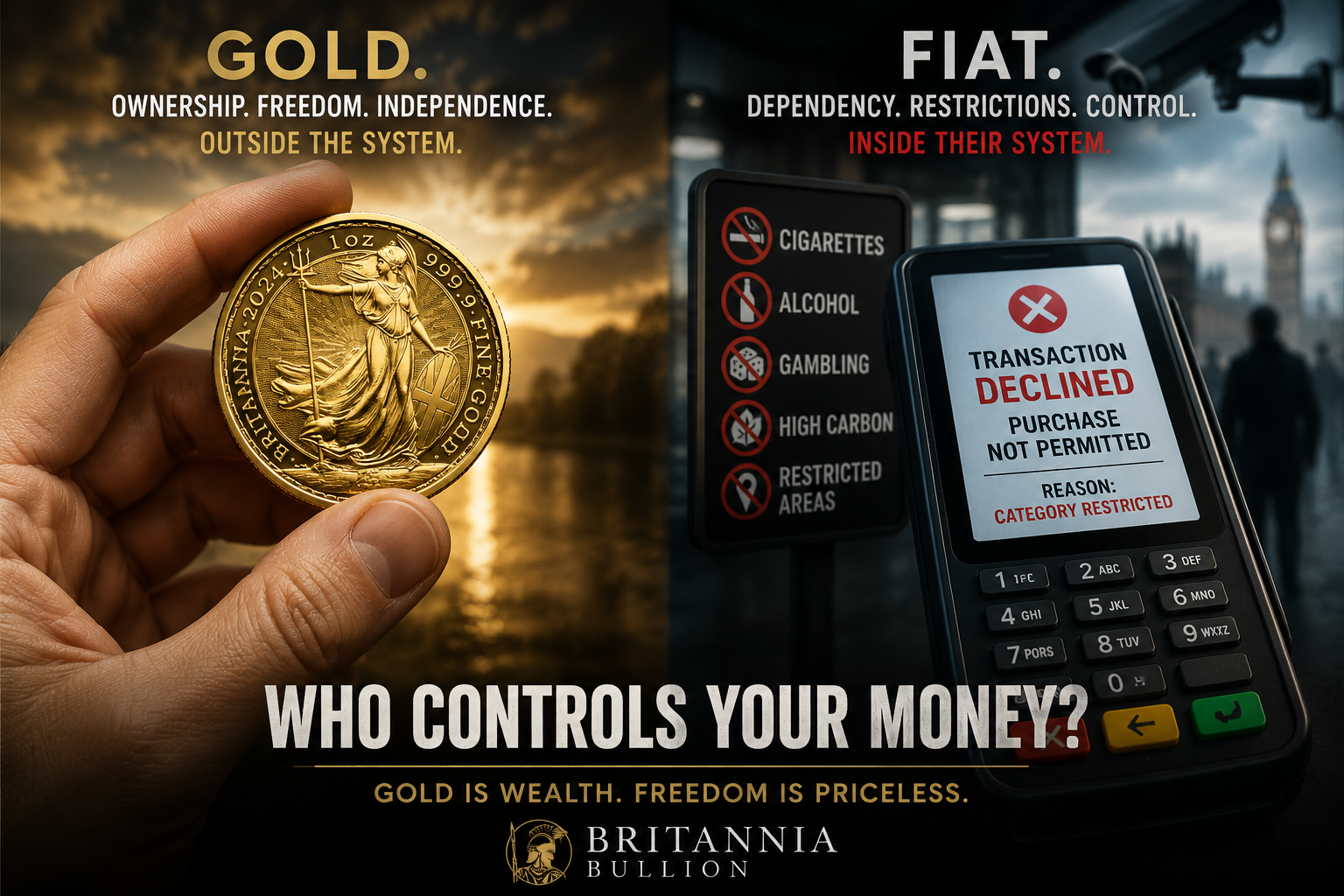
A government minister discussed plans to prevent certain individuals from spending money on specific products. Under the proposal, recently released prisoners would be unable to use allocated funds for purchases such as cigarettes, alcohol or gambling. The technology would simply prevent the transaction from taking place.
Many people will support this policy.
That is not the point.
The point is that the principle has now been established.
The technology exists.
The infrastructure exists.
And the precedent is being set.
For years, critics argued that governments could never control how people spend their money. Yet here we are discussing systems that can determine not only how much money someone possesses, but where, when and on what that money can be spent.
Every major change begins with a first step.
Every expansion of power begins with a justification.
And every new system has a Day One.
This may well prove to be one of those moments.

The Question Isn't Prisoners
The question is what comes next.
Today, it may be recently released offenders.
Tomorrow, it could be welfare recipients.
After that, perhaps carbon-intensive purchases.
Perhaps unhealthy products.
Perhaps certain types of travel.
Perhaps activities deemed socially undesirable.
The justification will always sound reasonable.
The objective will always sound sensible.
The target group will always be carefully chosen.
The concern is not what happens on Day One.
The concern is what happens on Day 3,650.
History teaches us that powers introduced for one purpose rarely remain confined to that purpose forever.
Programmable Money Changes Everything
For centuries, money has possessed one defining characteristic.
Once it belongs to you, you decide how to spend it.
Governments can tax it.
Banks can hold it.
But the decision ultimately remains yours.
Programmable money changes that relationship.
Instead of money being neutral, money becomes conditional.
Instead of money being a store of value, it becomes a tool of behavioural influence.
Spend here? Approved.
Spend there? Declined.
Travel here? Permitted.
Travel there? Restricted.
Purchase this? Accepted.
Purchase that? Blocked.
Many will argue such controls are beneficial.
Others will argue they are dangerous.
But nobody can honestly claim the capability does not exist.
The Disappearance of Financial Privacy
Cash provides anonymity.
Physical cash does not ask where you are.
It does not monitor your purchases.
It does not create a permanent record of every transaction.
Digital systems do.
Every step towards a fully digital financial system creates more data, more visibility and more oversight.
Supporters call it transparency.
Critics call it surveillance.
Whichever side you favour, one fact remains:
Cash offers freedoms that digital systems simply cannot.
Why Gold Matters
This is one reason physical gold remains relevant today.
Gold does not require an internet connection.
Gold does not require permission.
Gold does not depend upon a banking network.
Gold does not need software updates.
Gold cannot be programmed.
Gold does not care about political fashion, changing governments or social priorities.
For thousands of years, gold has represented financial independence.
Not because it generates income.
Not because it pays dividends.
But because it exists outside the promises and controls of others.
Physical gold is one of the few financial assets that remains entirely yours.
No algorithm decides how it may be used.
No government department determines whether a transaction is approved.
No central authority can alter its properties with a software update.
The Debate Has Changed
For years, the debate centred on whether governments could ever control spending through digital money.
That debate is over.
The capability exists.
The question now is where society chooses to draw the line.
Perhaps these powers will remain narrowly targeted.
Perhaps strong safeguards will prevent expansion.
Perhaps concerns will prove exaggerated.
We sincerely hope so.
But one thing is beyond dispute.
The first steps are now being taken.
The systems are being built.
The precedents are being established.
And the conversation that many dismissed as impossible is rapidly becoming reality.
The thin end of the wedge has a habit of arriving quietly.
Most people only notice the wedge once it is fully driven in.
Perhaps these powers will never expand beyond their original purpose. We sincerely hope that is the case. But history teaches us that freedoms are rarely lost all at once. They disappear gradually, one exception, one emergency, one justification at a time. Physical gold has survived every government, every currency and every experiment in monetary control. Long after today's politicians, policies and payment systems are forgotten, an ounce of gold will remain an ounce of gold. The question is not whether gold will endure. The question is whether your financial freedom will.
Good luck.

Disclaimer: This communication is for information purposes only and should not be considered financial advice. The value of investments can fall as well as rise, and past performance is not a guarantee of future results.