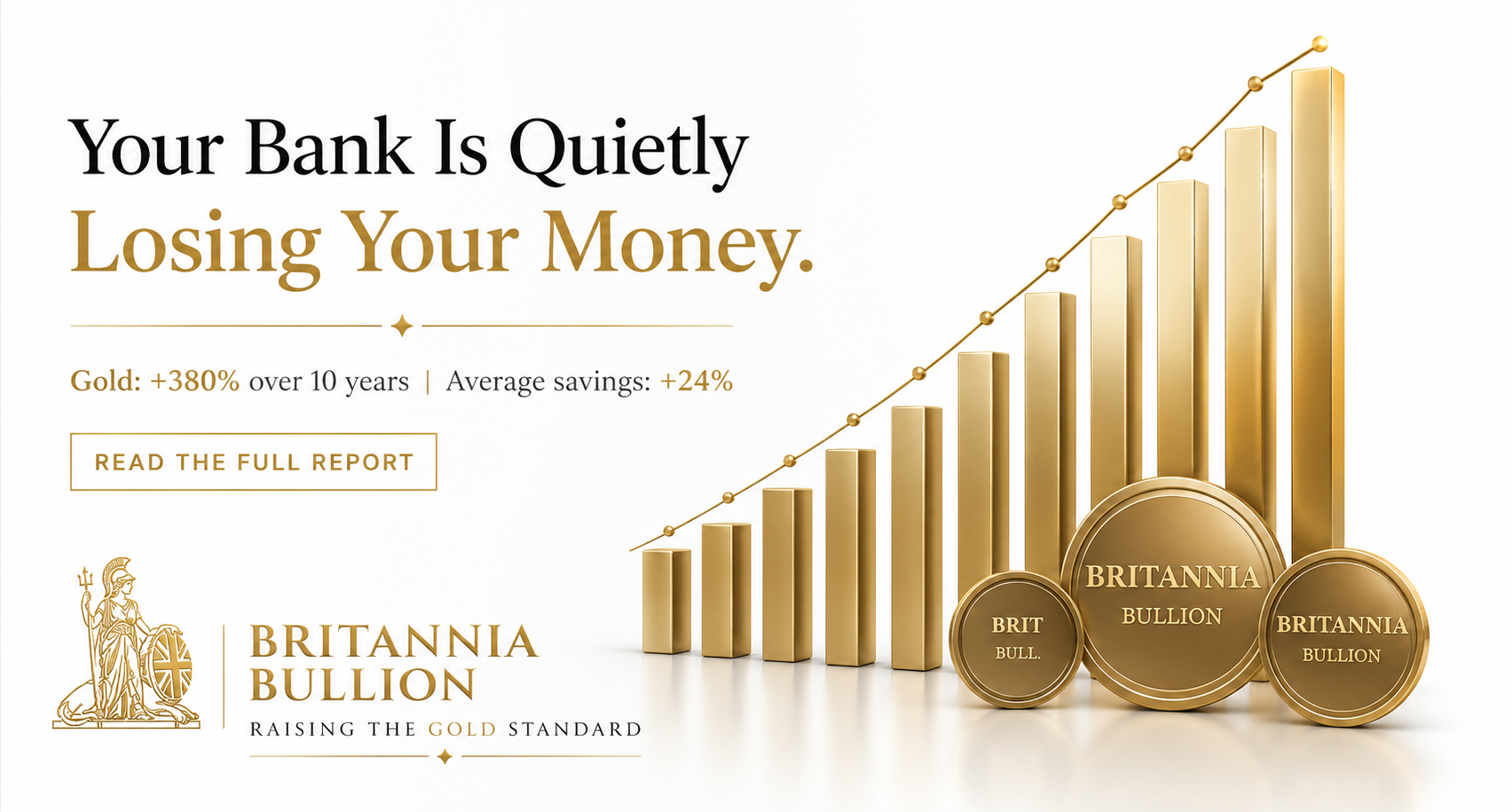
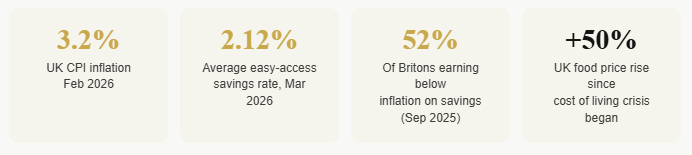
UK food prices are on track to be 50% higher than at the start of the cost of living crisis. Savings accounts average just 2.12%. And gold has returned over 380% in a decade. The numbers don't lie, so why are most Britons still relying on conventional savings?
Let us be direct with you. The financial products most British savers rely upon, cash ISAs, easy-access savings accounts, even fixed-rate bonds, are, in many cases, doing little more than treading water against inflation. Some are losing ground entirely. This is not a matter of opinion. It is a matter of publicly available data, and we have laid it out for you below.
This article compares gold against the conventional alternatives: cash savings, the FTSE 100, and property. Every figure cited is drawn from publicly verifiable sources. We will let the data speak, then you can decide.
The inflation problem nobody wants to say out loud
Inflation in the UK stood at 3.2% in February 2026. The average easy-access savings account pays just 2.12%. That means the average British saver is losing real purchasing power every single year, quietly, invisibly, and without a single news headline.
UK food prices are projected to be 50% higher than they were at the start of the cost of living crisis five years ago. Think about that. If your savings grew by 10–12% over five years, a reasonable outcome from a high-street savings account, your money buys significantly less today than it did when you put it away.
Gold vs everything else: the 10-year reality
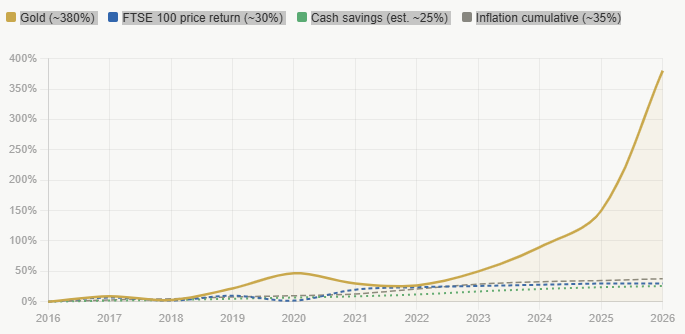
In January 2016, gold traded at approximately $1,078 per ounce. Today it trades above $4,500. That is a return of over 380% in ten years. Below is how that compares to every conventional option available to UK savers over the same period.
Comparing your options honestly
Here is a straightforward comparison of the main savings and investment options available to UK savers, with no spin, just the facts.
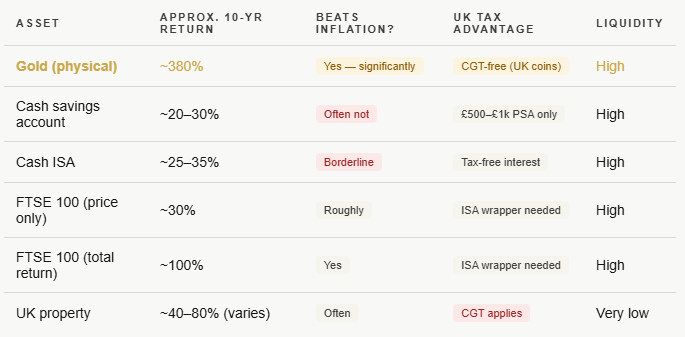
One figure in that table deserves particular attention: UK gold coins, such as Britannia's and Sovereigns, are exempt from Capital Gains Tax as legal tender. This is not a loophole. It is enshrined in UK law. Whether you are a basic-rate or additional-rate taxpayer, this single fact alone can make physical gold one of the most tax-efficient assets available to British investors.
What £10,000 would have become
Firstly a 5 year period below to see what £10,000 placed in each asset would be worth today, using real historical data, and then 10 years.
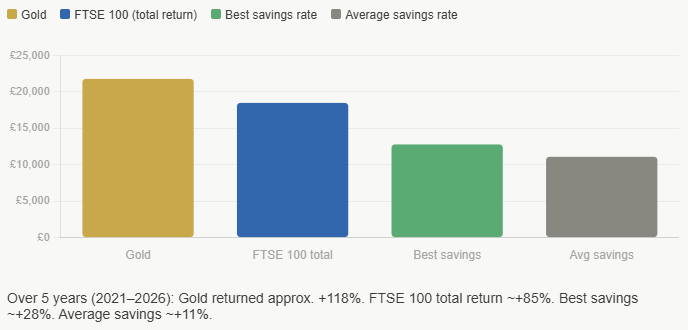
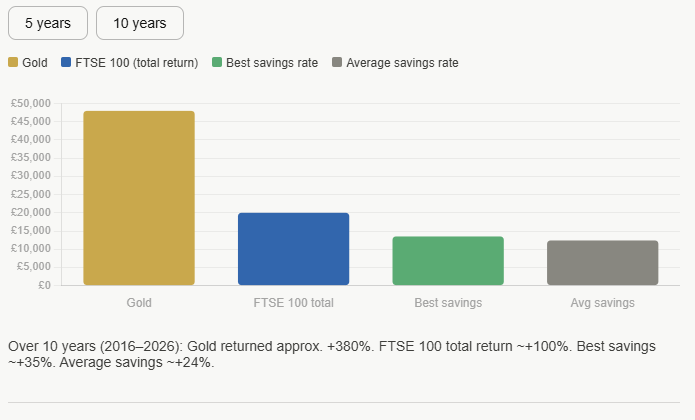
Why now, not later
Central banks worldwide are buying gold at the fastest pace in decades. The US dollar faces structural questions. Geopolitical instability, from the Middle East to trade wars, is not abating. And Peter Schiff, Euro Pacific Asset Management, has publicly stated what many serious economists are now considering: that we may be witnessing the early stages of a monetary realignment away from dollar dominance.
None of this is to say that gold is without risk, or that it rises in a straight line. It does not. But for the patient, long-term investor, particularly one concerned about inflation, currency debasement, or systemic financial risk, the historical record is unambiguous.
Gold has been the best-performing major asset class over a decade. It is tax-free for UK investors buying coins. It is tangible, private, and portable. And unlike a savings account, no bank can freeze it, lend it out, or fail and take it with them.
The information in this article is for educational purposes only and does not constitute financial advice. Past performance is not indicative of future results. The value of investments can fluctuate and you may not recover the amount originally invested. Tax treatment depends on individual circumstances and may be subject to change. If you are unsure, please seek independent financial advice. Data sources: ONS, Finder UK, Moneysaving Expert, World Gold Council, JM Bullion, IG UK, Trading Economics.