.png)
Is the Glass Half Full—or Half Empty?
Ten simple questions that could tell you more about the future of your money than any market forecast
Are you an optimist or a pessimist?
Do you see the glass as half full—or half empty?
When it comes to protecting your wealth, neither label is especially helpful. Optimism does not preserve purchasing power, and pessimism alone is not an investment strategy.
What matters is whether the forces surrounding your money are improving or worsening—and whether your financial position reflects your honest assessment.
So, forget forecasts for a moment. Ignore the headlines, predictions and price targets. Instead, answer ten straightforward questions.
There are no complicated calculations and no right or wrong answers. Simply decide whether you believe each situation is getting better or worse.
1. Government debt: improving or worsening?
Governments across the developed world continue to carry enormous—and growing—levels of debt.
Servicing that debt becomes increasingly expensive when interest rates rise, placing further pressure on government finances. That can lead to more borrowing, higher taxation, spending cuts or further currency creation.
Do you expect global government debt to be materially lower five years from now?
Improving—or worsening?
2. The purchasing power of cash: strengthening or weakening?
The number printed on a bank statement may remain unchanged, but the amount it can purchase does not.
Inflation does not need to remain exceptionally high to cause lasting damage. Even moderate inflation compounds over time, steadily reducing what each pound can buy.
Do you believe the money sitting in your bank will purchase more—or less—in five or ten years?
Strengthening—or weakening?
3. Inflationary pressure: rising or falling?
Inflation may move up and down from one month to the next, but many of its underlying drivers remain firmly in place.
Energy insecurity, disrupted trade routes, geopolitical tensions, increased defence expenditure, labour shortages and the cost of servicing government debt can all feed into the prices paid by businesses and households.
The real question is not whether inflation temporarily falls. It is whether the era of reliably low and predictable inflation is returning.
Getting better—or getting worse?
4. The banking sector: becoming safer or more vulnerable?
Banks sit at the centre of the modern financial system, but confidence in that system cannot simply be assumed.
Higher borrowing costs place pressure on households, companies, commercial property and government bonds. Meanwhile, increasingly digital financial systems introduce new questions about access, privacy and control.
Do you believe the banking sector is becoming more resilient—or accumulating additional risk beneath the surface?
Safer—or more vulnerable?
5. The risk of war: decreasing or increasing?
Existing wars remain unresolved. Defence budgets are rising. Long-standing alliances are being tested, while regional conflicts carry the potential to draw in larger powers.
Modern warfare also extends far beyond the battlefield. Cyberattacks, sanctions, frozen reserves, attacks on infrastructure and restrictions on trade can affect countries and investors thousands of miles from the original conflict.
Do you believe the risk of further escalation is lower today than it was five years ago?
Decreasing—or increasing?
6. Global trade and energy security: stabilising or deteriorating?
The global economy depends on a relatively small number of ports, canals, pipelines and shipping routes.
When even one important route becomes restricted or unsafe, the consequences can spread quickly through energy markets, transport costs, food production and consumer prices.
Businesses can adapt, but alternative routes are frequently longer, slower and more expensive.
Do you expect global trade to become safer, cheaper and more predictable—or increasingly exposed to political pressure and disruption?
Stabilising—or deteriorating?
7. Political stability: improving or weakening?
Economic pressure rarely remains purely economic.
Falling living standards, higher taxes, unaffordable housing and distrust in institutions can produce political fragmentation. Governments under pressure may then pursue more intervention, higher spending or short-term policies intended to satisfy increasingly frustrated voters.
Across the world, do you see greater political cooperation and stability—or deeper division and uncertainty?
Improving—or weakening?
8. Confidence in traditional currencies: rising or falling?
Modern currencies are supported by confidence: confidence in governments, central banks and the long-term value of the money they issue.
Yet persistent deficits and rising debt create an uncomfortable dilemma. Governments need growth and manageable borrowing costs, but aggressively fighting inflation can place further pressure on both the economy and public finances.
If more currency must ultimately be created to support an ever-expanding burden of debt, what happens to the long-term value of each existing pound, dollar or euro?
Confidence rising—or confidence falling?
9. Financial privacy: expanding or disappearing?
Money is becoming increasingly digital, traceable and programmable.
Digital payments offer speed and convenience, but they also leave individuals more dependent on banks, technology providers and centralised systems. Cash use is declining, while governments and central banks continue to explore new forms of digital currency.
Do you believe individuals will have greater financial independence and privacy in the future—or less?
Expanding—or disappearing?
10. Central-bank demand for gold: increasing or decreasing?
Central banks understand currency risk better than almost anyone. They issue money, manage national reserves and monitor geopolitical and financial threats on a daily basis.
They also understand an important distinction: currencies are someone else’s promise, while physical gold is an asset with no issuing government and no corresponding liability.
If the institutions responsible for managing national reserves continue to regard gold as strategically important, private investors should at least ask why.
Do you expect central banks to become less interested in physical gold—or more?
Decreasing—or increasing?
Now Look Back at Your Answers
How many times did you choose the more optimistic answer?
If you believe debt will fall, currencies will strengthen, wars will subside, inflation will remain controlled, banking risks will diminish and financial privacy will expand, maintaining your existing financial position may feel entirely reasonable.
But what if most of your answers pointed in the opposite direction?
What if you believe debt will grow, purchasing power will weaken, geopolitical tensions will intensify and confidence in currencies and financial institutions will become increasingly fragile?
That does not necessarily make you a pessimist.
It may simply mean you are paying attention.
And it raises one final question:
Is your wealth positioned for the world you genuinely believe is coming—or the world you hope is returning?
Where Physical Gold Fits
Physical gold does not require every risk discussed above to become a full-scale crisis.
It does not require the collapse of a currency, the failure of a bank or the outbreak of a wider war. Gold can become more relevant simply because uncertainty is rising, confidence is weakening and the purchasing power of conventional money is under sustained pressure.
Unlike cash, gold cannot be created at the touch of a button.
Unlike a bank deposit, it is not dependent upon the financial strength of a commercial institution.
Unlike a bond, it does not rely upon a government or company honouring a future promise.
Physical gold is not designed to replace every other asset. Its purpose is different. It can provide diversification, independence and a tangible store of value outside the conventional financial system.
For investors whose answers suggest that financial and geopolitical risks are worsening, holding an allocation to physical gold is not an act of panic.
It is an act of preparation.
Half Full—or Being Diluted?
Perhaps the most important question is not whether the glass is half full or half empty.
It is whether what remains inside it is being steadily diluted.
You do not need to predict precisely what happens next. You simply need to decide whether the risks surrounding your wealth are becoming smaller or larger—and whether your current arrangements leave you adequately prepared.
If you answered “worsening” more often than “improving”, you are already perfectly positioned to understand why physical gold deserves serious consideration.
About the Author
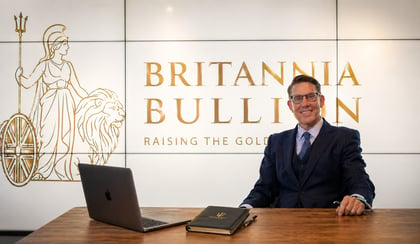
Matthew Jones is Co-Founder and Precious Metals Analyst at Britannia Bullion. He provides market commentary and analysis on gold, inflation, government debt and the geopolitical forces affecting private wealth. Britannia Bullion helps investors purchase, securely store and sell physical gold, with a particular focus on wealth protection, preservation and legacy planning.
This article is provided for general information and educational purposes only. It does not constitute personalised financial, investment, tax or legal advice. The value of gold can rise as well as fall, and past performance is not a reliable indicator of future results.
|
Matthew Jones Co-Founder Precious Metals Analyst Britannia Bullion |